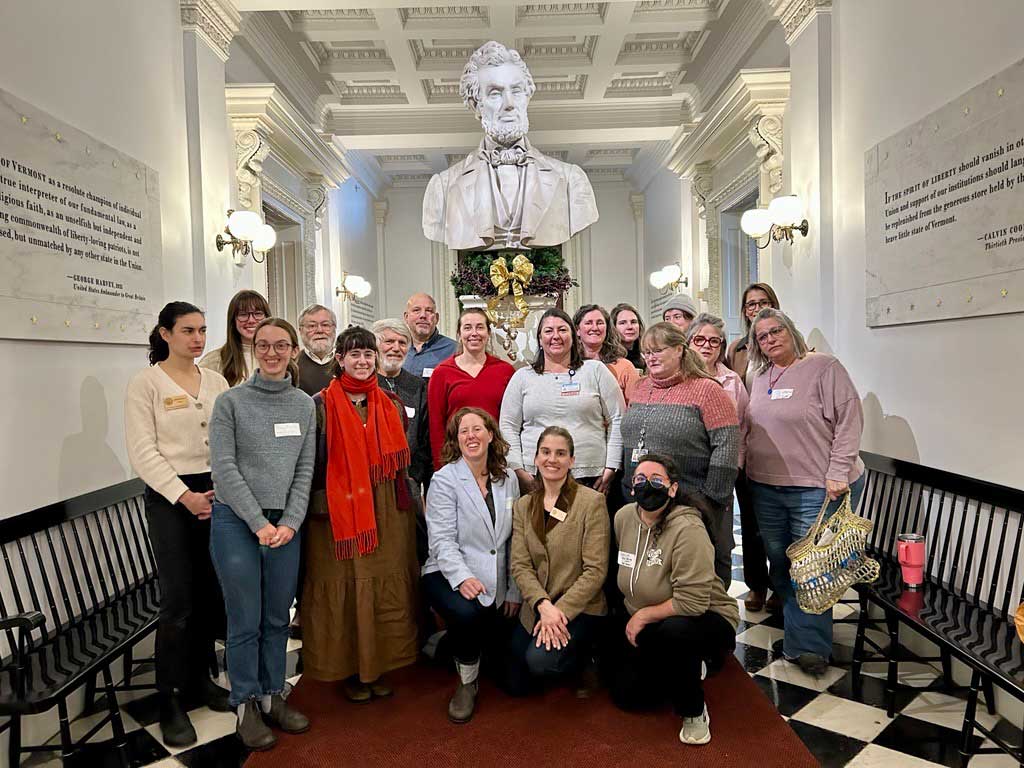
The 2026 Legislative Session, and second and final year of the 2025-2026 biennium, came to a close on Friday, May 29. There were a lot of ups, some downs, and many bills passed just before the deadline. We saw an increased awareness of food security, with some surprising champions stepping forward! These champs’ commitment to feeding people across Vermont shows that our continued efforts to educate and cultivate support within the legislature are working! However, there was also a steep reduction in available state funding, which made choices even harder for the legislature as they allocated budget funds to important programs and efforts across the state.
Within this difficult funding climate, we received funding support and some important policy support—a huge overall win—as did several key food security programs championed by the Vermont Food Security Coalition. This session’s recap is below, but feel free to reach out with questions! It is a bit of a long one, so settle in!
See below for details on:
- What we asked for from the Vermont State Administration and Legislature
- What ended up in the FY27 State Budget
- Vermont Food Security Coalition advocacy results
- What comes next…
Requests to the Governor’s Administration
Before the 2026 legislative session even began, we asked the Governor’s administration to fund our legislative requests in the Governor’s recommended FY26 budget adjustment and the State FY27 budget. (Quick note on state fiscal years: they do not align with calendar years. State of VT fiscal years begin on July 1 and end on June 30, meaning FY26 ends on June 30, 2026, and FY27 begins on July 1, 2026.)
We specifically focused our Budget Adjustment request on the funding needed to purchase local food through Vermonters Feeding Vermonters (VFV) program funding because the legislature passed Act 34 of 2025 last year. This Act made VFV a grant program of the Agency of Agriculture, Food and Markets, which Vermont Foodbank implements.
View our FY26 Budget Adjustment for $1.5 million for local food purchases through Vermonters Feeding Vermonters
(Result: $385,000 in state funding for VFV to be spent by June 30, 2026)
In addition to funding the Vermonters Feeding Vermonters program, due to the SNAP pause in 2025 and floods in 2023 and 2024, we focused our FY27 request on creating a “Ready Response” to ensure food is available during the initial phase after an emergency or disaster. And, in the face of rising use of food shelves and meal sites, we asked for support to be sure our network partners’ shelves are stocked.
Our FY27 requests to the administration included:
- FY27 budget funding for $2 million to support local food purchases through Vermonters Feeding Vermonters
- FY27 budget funding for $2 million to support food distribution by our network of partners
- FY27 budget funding for $1 million to create a Ready Response for disasters and emergencies
Unfortunately, we were not successful in getting those funds into the Governor’s recommended budgets ahead of the legislative session. So, we brought our requests to the legislature to ask for support of our shared work to keep neighbors fed.
Our Legislative Advocacy and Results
These three requests were governed by six different committees in the Vermont House of Representatives and Senate. We spent much of January – April working with partners and neighbors from across the state to educate lawmakers about critical food programs, the need for additional support for food access, and how all of these efforts work together to get Vermont closer to food security for everyone who lives here.
We owe thanks to you, our partners, neighbors, and volunteers who testified, wrote legislators, shared personal knowledge and expertise, and worked alongside advocates and legislators to make this information accessible to decision makers. Without your knowledge, input, and engagement, we would not have had the success we did this year.
Budget appropriations are done in two or three parts. First the Vermont House Appropriations Committee determines the House version of the budget. Then, the Vermont Senate Appropriations Committee takes the budget and reworks it based on their priorities. If the House and Senate versions of the budget don’t agree (they rarely do), the budget goes to a Committee of Conference to work out the differences between the House and Senate versions.
This year, the Vermont House Appropriations Committee included several of our requests in their version of the budget, but at lower amounts than were requested. When the Vermont Senate Appropriations Committee’s version of the budget passed that body, it was not in agreement with the House budget on our requests, among other things. Because the two versions of the budget did not agree, a Committee of Conference was formed and members of the VT House and Senate worked out their differences. You can see the final “Food Package” being discussed in the Budget Committee of Conference in this clip on May 28th.
In the final FY27 budget the legislature chose to fund our priorities with:
- $550,000 in one-time funding in FY27 to support network partners’ food distribution
- $250,000 in one-time funding in FY27 for Vermonters Feeding Vermonters’ local food purchasing
Ready Response was not funded this year, but a program was created in statute through the passage of H.935, which allows for this work to be implemented when funding is available. We will continue to work with state partners to ensure they understand the importance of planning ahead for food access in emergencies and disasters by allocating the funding needed.
Vermont Food Security Coalition Priorities and Outcomes
Thanks to the work of coalition partners, farmers, coalition allies, neighbors, and dedicated legislative champions, many Vermont Food Security Coalition priorities were also included in the state budget. First and foremost, priorities related to the continued robust operation of 3SquaresVT (federally known as SNAP) were funded. 3SquaresVT remains Vermont’s most efficient and effective anti-hunger program, in spite of threats from federal changes passed in HR.1 last summer. We are heartened to see the importance of SNAP/3SVT this acknowledged by our State leadership with continued support and additional efforts to bolster 3SquaresVT access for everyone who is eligible:
- 3SquaresVT/SNAP funding: Full funding was included in the budget to ensure the Agency of Human Services had the administrative resources needed to operate 3SquaresVT, in light of a 25% reduction in federal funding. This means that Vermont protected the operation of this program for the 60,000 shoppers who participate, and the 600+ grocers and farmers who depend on it for their bottom lines.
- Benefit Assisters: $3.5 million was allocated for 3SquaresVT and Medicaid benefit assistance at service-providing organizations to help Vermonters navigate complex changes to eligibility and paperwork requirements for both programs. This investment supports the best outcomes for Vermonters by ensuring all eligible people are able to stay enrolled in these important benefit programs AND keeps federal dollars in our state. This is in addition to Vermont Foodbank’s 3SVT Team who is already a SNAP Outreach Partner.
- Act 104: This 2018 law was amended to increase engagement and communication between the Department for Children and Families and key stakeholders—including community organizations and SNAP-authorized retailers—when there are mandatory or optional proposed changes to the 3SquaresVT/SNAP program.
And, because of the hard work of partners and advocates across the state, the legislature included critical funding for food security programs across Vermont:
- Child and Adult Care Food Program: A total of $157,000 was appropriated to increase access to meals and snacks in childcare settings. This money will allow sponsor organizations to continue operating the CACFP for Family Child Care Homes and start outreach to bring the CACFP to even more providers.
- $350,000 to NOFA-VT to operate Crop Cash, Crop Cash Plus, and Farm Share programs. While this is less funding than is needed to operate the programs at their current level, NOFA-VT is grateful to be able to continue operating all three programs in the next fiscal year.
- $350,000 to Bridges to Health, a program that supports health outreach and care coordination for immigrant and migrant workers and their families across Vermont.
- $150,000 for the Vermont Language Justice Project to support their work in translating public health emergency materials.
- Funding to the Land Access and Opportunity Board to support operations and programs.
- S.60, the policy creating the Farm & Forestry Operations Security Special Fund, was passed. No funding was allocated to the fund, which is intended to provide payments for farm and forest business losses due to extreme weather conditions.
These WINS are critical to food security support across Vermont – and we will know this week if the Governor chooses to sign the budget, ensuring that programs are funded on time and can continue critical work when the State Fiscal year begins on July 1.
And we want to recognize that this support is not enough. With more people needing food assistance, food prices climbing, and other costs like high fuel prices putting pressure on households and the food assistance system, we will continue to need the State of Vermont to step into leadership to ensure everyone is fed. We have made great strides over the past five years, but there is more work to do.
What Comes Next…
If you are ready to get to work and say, “Food security is a policy choice” to our next group of elected officials, there is no time like the present to begin! 2026 is an election year!
Last week was the filing deadline for those running for Vermont House and Senate, as well as statewide offices like Governor, Lt. Governor, and Treasurer. This means you will have many opportunities to ask local and statewide candidates about their commitment to food security for everyone in Vermont! You don’t need any special process to reach out to people running in your district – simply look up their campaign website and email them, or talk with them at a local community event. Many candidate forums happen over the summer. We don’t have a comprehensive list, but if you see one happening, consider attending and asking questions.
Here are a few questions you can consider asking your local candidates about food security priorities:
- If elected, how will you design and support solutions resulting in food security for everyone in Vermont? Does that work differently for rural, suburban, and urban areas?
- If elected, how will you support Vermont farms that grow our food so that both farmers and the people they feed are food secure?
- If elected, how will you protect and defend access and funding for critical programs like 3SquaresVT that feed neighbors and support our local food retailers?
Upcoming opportunities to engage with candidates (we have only seen panel conversations from the Democratic Party, please share Republican Party primary panel discussions with us if you know of them!):
Democratic Primary for Governor featuring Amanda Janoo and Aly Richards
Monday, June 15, 2026 | 6:00pm-7:30pm
Vermont Farmers Food Center
251 West St, Rutland, VT
Register on the VCV website
Democratic Primary for Governor featuring Amanda Janoo and Aly Richards
Wednesday, June 17, 2026 | 6:00-7:30pm
Vergennes Opera House
120 Main St, Vergennes, VT 05491
Register on the VCV website
Thank you for your continued engagement, curiosity, and support for food security for everyone in Vermont. Together, we can ensure that everyone in Vermont is food secure in partnership with elected leaders and our state.
Onward in partnership,
Carrie
P.S. As part of our effort to address the root causes of food insecurity, we support the Paid Leave Coalition. Help them make it across the finish line on their goal of collecting 802 Reasons (why Vermont needs paid leave) Campaign! Do you have experience with Paid Leave, or WISH you had paid leave when you needed it for recovery from a medical event, to care for someone in your family, or to bond with a new baby or child? Please share your story and help our coalition reach 802 Reasons!


Food insecurity is a solvable problem. While the bulk of the Foodbank’s work is distributing nourishing food every day, the team is also working at addressing hunger by advocating for policies that can ultimately end hunger.

It has been a busy few weeks in Montpelier and we've now crossed the mid-point of the Vermont state legislative session, called “crossover” under the golden dome in Montpelier.
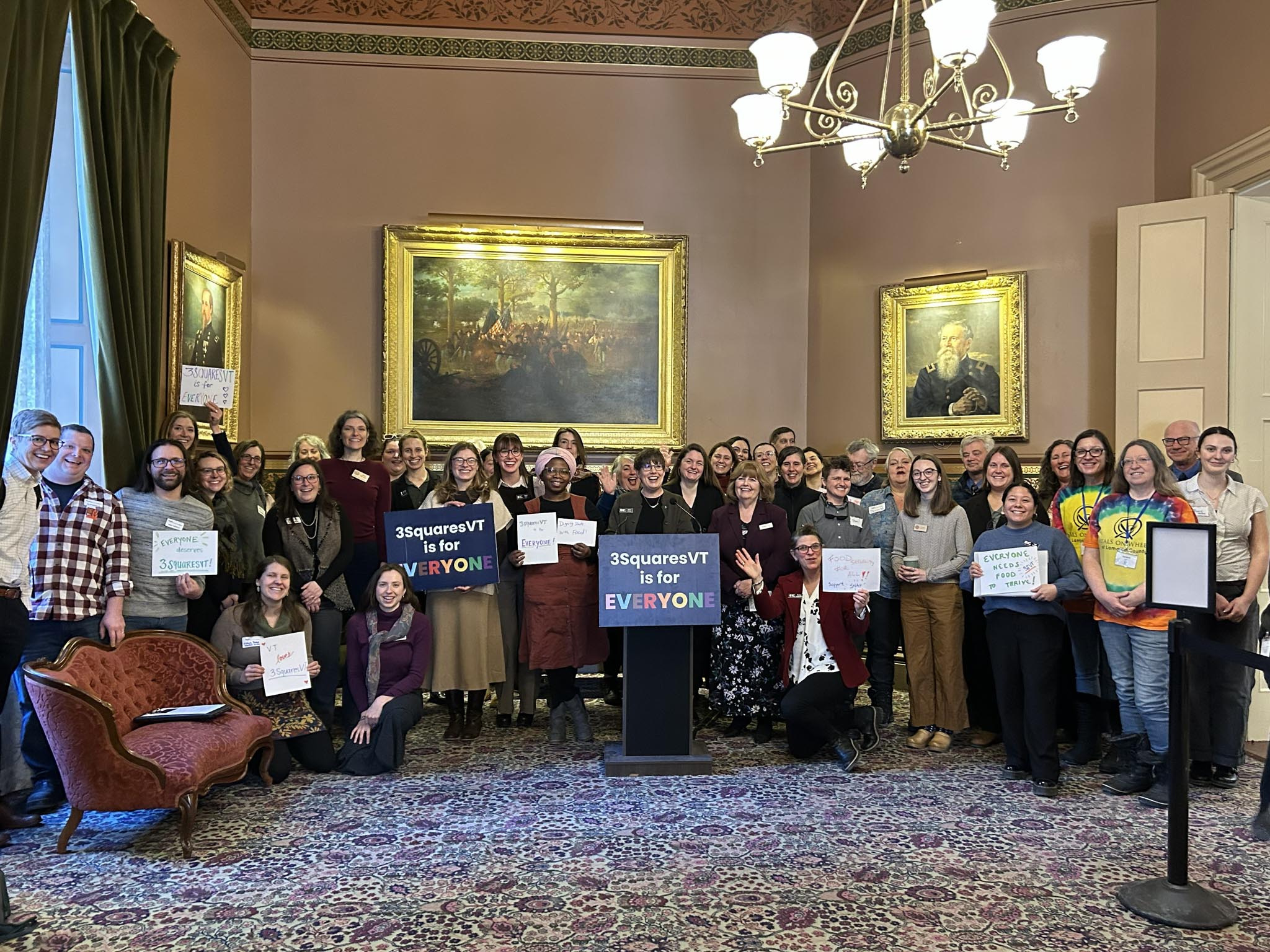
Together with community advocates and partners, we are helping legislators in the State House understand why 3SquaresVT and food security programs are important to achieve food access and security in Vermont.