Now that you’ve learned a bit about our food sources and distribution routes (see Part Two and Part Three in this series), you may be wondering: what happens once the food arrives to one of the three Vermont Foodbank distribution centers?
Moving food from suppliers to the Foodbank to our community partners and neighbors involves many steps and many hands. Let’s go behind the scenes to see what happens in our warehouses between 7am and 3pm each business day:
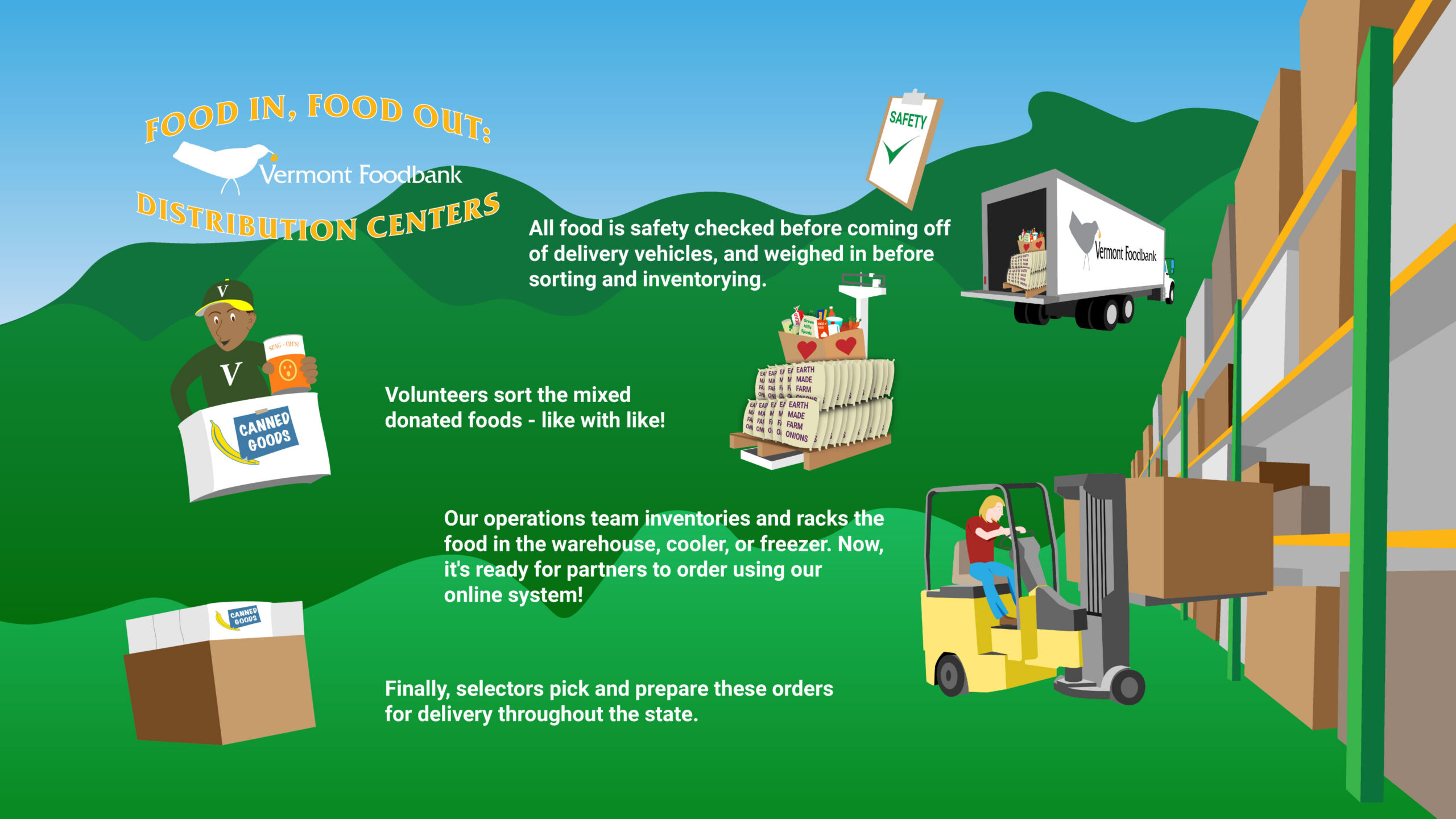
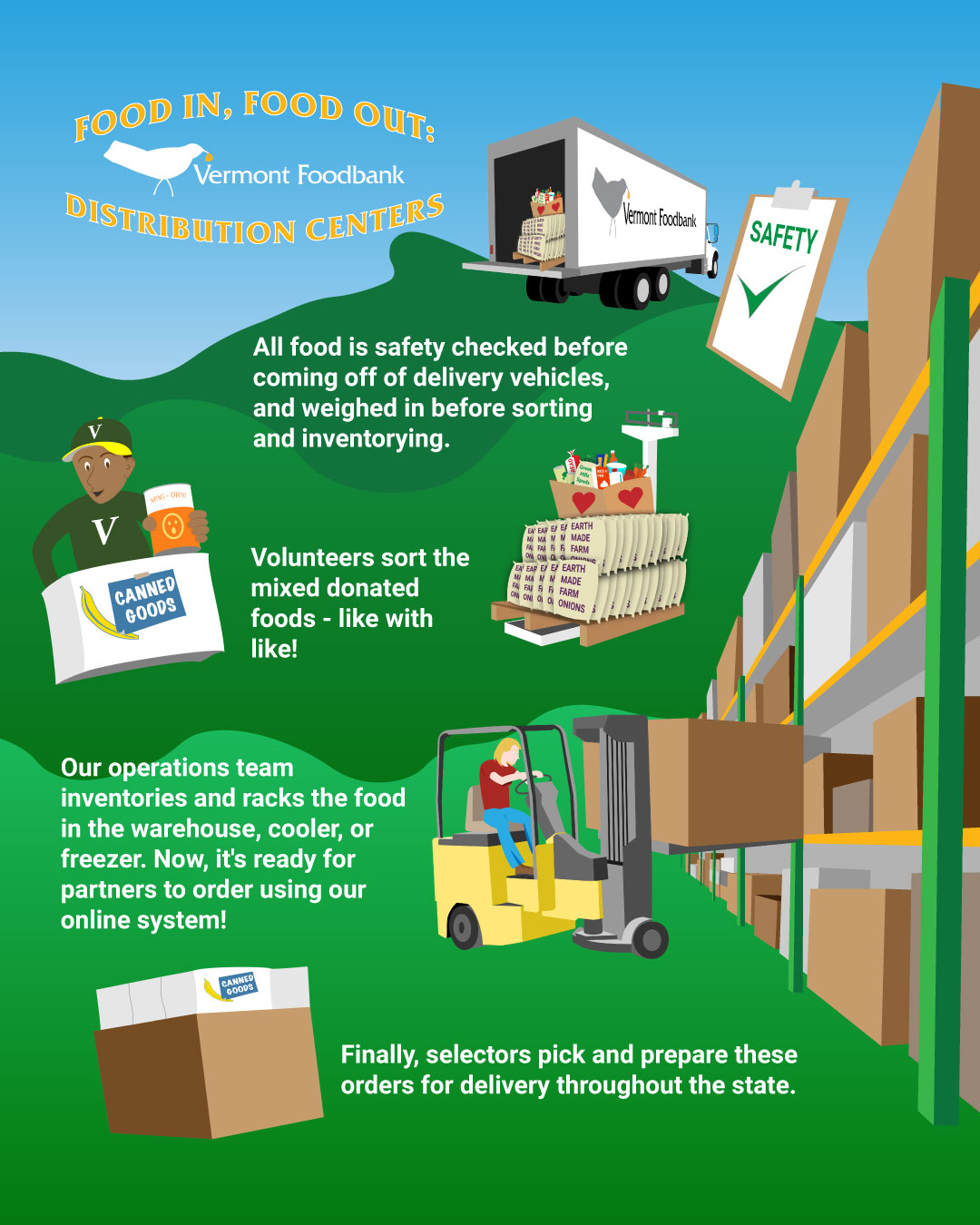
- The very first thing that happens when a truck of food arrives is that all items—donated or purchased—go through an initial safety check. This happens before pallets and boxes even leave the truck.
- What happens next depends on the food source and type. (Learn more about our food sources here and the annual breakdown in our annual report located here). Large quantities of a single product are weighed, inventoried and placed on racks in the main warehouse, refrigerator or freezer.
- If the delivery is a mixed shipment of shelf-stable donated food, we move it to a containment room for pre-sorting and further safety checks, then to a sorting room where volunteers sort the foods into banana boxes by type (such as condiments, beverages, etc.). A member of our operations team weighs the sorted boxes of product before they’re inventoried and placed on racks.
- Now the food is ready for our network partners to order! Using an online ordering system, the food shelves and meal programs we partner with can select the foods they want to pick up or have delivered to their site. Partners place an order at least a few days in advance of when it will be delivered or picked up, to ensure that the Foodbank team has time to fulfill the order.
- Finally, selectors on our operations team pick the needed pallets and organize partners’ orders by route and delivery day. Each morning, the logistics team gathers these orders and brings them to the loading dock, where they are loaded onto the truck for delivery. Team members move the food using electric pallet jacks and forklifts. The operations team has a monthly delivery schedule with set days and times for all partners, and partners can pick up items at any of the distribution centers between deliveries (up to once per week).
This complex multi-step process that involves multiple safety checks and rigorous storage standards helps ensure that all food we distribute is high-quality, nourishing, and safe to eat. AIB International, a non-profit that conducts food safety audits throughout the world, inspects all Foodbank facilities and reviews our procedures on a regular basis. Many people play a key role in making this process happen smoothly every day, from our wonderful operations team to the many generous volunteers who share their time and skills to support their neighbors. Together, everyone involved is helping us get more than 14 million pounds of food from all sources out to partners and neighbors each year.
And, this only represents a piece of the puzzle – the Foodbank also supports partners in developing supplier relationships to receive food donations directly. Network partners can also directly source produce from farms through the Vermonters Feeding Vermonters program.
Download an accessible PDF of this infographic.
Up next: Learn more about where all of this food is heading once it leaves our distribution centers.